Frequencies Forward: How Gen Z Is Rewiring Lennon's Peace Vision for a Digital Age
In the autumn of 1971, John Lennon released a song that asked listeners to do something extraordinarily difficult: to imagine a world that did not yet exist. The request was not merely poetic. It was structural. "Imagine" demanded that its audience suspend the architecture of the present long enough to glimpse an alternative. More than five decades later, that same demand — urgent, unresolved, and increasingly complicated — is being transmitted through mediums Lennon never touched, by a generation that was not yet born when he was taken from us.
Gen Z activists, artists, and organizers across the United States are engaging with Lennon's legacy in ways that are neither simple tribute nor wholesale rejection. What is unfolding is something more nuanced: a creative negotiation between an analog-era prophet and a generation that has known nothing but digital noise. Understanding that negotiation requires looking carefully at both what has been preserved and what has been fundamentally transformed.
The Inheritance They Chose
Among the aspects of Lennon's philosophy that resonate most powerfully with young American activists, the concept of radical visibility stands near the top. The Bed-Ins for Peace — those deliberately theatrical demonstrations staged in Montreal and Amsterdam — established a principle that Gen Z organizers have internalized without necessarily knowing its origin: that the personal space, made public, becomes a political argument. When young activists livestream their organizing meetings, post unfiltered footage of community care work, or document their emotional labor in real time, they are operating within a tradition Lennon helped pioneer.
The commitment to nonviolence as an aesthetic and strategic stance also carries forward, though with significant revision. Lennon understood that peaceful protest was not merely morally preferable — it was tactically disruptive in a media landscape that expected rage. Gen Z has absorbed that lesson and applied it to digital environments, where a composed, visually arresting image or a quietly devastating caption can outperform a furious screed in terms of reach and impact. The medium has changed. The underlying logic has not.
Perhaps most strikingly, Lennon's insistence on art as activism — his refusal to separate the creative act from the political one — finds a direct echo in the explosion of digital art circulating through social movements today. Climate justice murals, illustrated protest zines shared as Instagram carousels, original music produced in bedroom studios and uploaded to platforms with global reach: these are the contemporary equivalents of "Give Peace a Chance" recorded in a hotel room with borrowed instruments and borrowed time.
Where the New Generation Parts Ways
Yet the departures are as instructive as the continuities. Lennon's activism, for all its genuine radicalism, operated within certain assumptions that Gen Z has been willing — sometimes eager — to interrogate.
The most significant point of divergence concerns identity and representation. Lennon's peace movement, however sincere, was largely centered on a white, male, Western perspective. Its universalism — the very quality that made "Imagine" feel so expansive — could also function as an erasure, collapsing specific histories of oppression into a generalized human longing. Contemporary young activists, shaped by the intellectual frameworks of intersectionality and the lived experience of a more demographically diverse America, have been explicit about their discomfort with movements that ask marginalized communities to set aside their particular grievances in service of a broader vision.
This is not a rejection of peace. It is a more precise definition of it. When Gen Z organizers insist that peace without justice is merely the absence of visible conflict, they are refining Lennon's argument rather than abandoning it — pushing it toward a rigor it sometimes lacked.
There is also a meaningful difference in relationship to celebrity and charismatic leadership. Lennon was, by any measure, a singular figure — a man whose fame amplified his message to a degree that no structural organizing could have replicated. Gen Z movements, shaped partly by the failures of top-down activism and partly by a healthy skepticism toward institutional authority, tend to distribute leadership more deliberately. The influencer who goes viral for a peace message is celebrated, but the decentralized mutual aid network operating without a famous face is equally — sometimes more — respected. Lennon's model was brilliant for its moment. The current generation is building something with different load-bearing walls.
The Algorithm as Amplifier and Distortion
Perhaps the most complex dimension of this inheritance is the role of digital platforms themselves. Lennon worked within a media environment that was powerful but relatively slow — a song had to be pressed, distributed, and played on the radio before it reached a mass audience. Today, a fifteen-second video can cross the globe before its creator has finished breakfast.
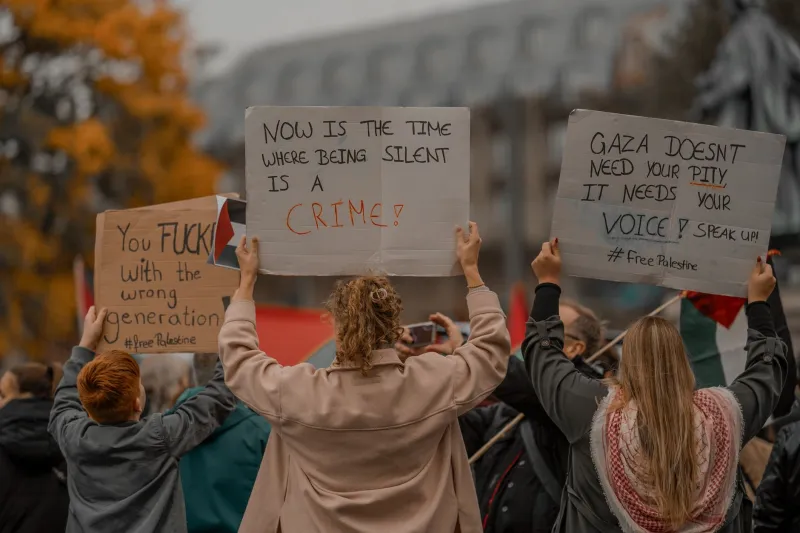
This speed creates extraordinary possibilities for organizing and solidarity. When protests erupted across American cities in the summer of 2020, the coordination that occurred via social media had no real precedent in Lennon's era. Images, information, and mutual support moved at a velocity that would have astonished him.
But the same platforms that amplify peace messaging also commodify it. Lennon's image is licensed and sold. His lyrics appear on merchandise. "Imagine" is deployed in advertisements with a regularity that would have horrified its author. Gen Z activists are acutely aware of this dynamic — many have written and spoken extensively about the way social media platforms extract attention and data from movements while offering reach in return. The transaction is not clean. The question of how to use these tools without being used by them is one Lennon never had to answer, and it remains genuinely open.
Reimagining the Dreamer
What emerges from this examination is not a portrait of a generation that worships Lennon uncritically, nor one that has discarded him as a relic of a less sophisticated era. It is something more interesting: a generation that treats his vision as source material rather than scripture.
In music production, this is called sampling — taking a fragment of something that came before, isolating what is essential, and building something new around it. Gen Z is sampling Lennon's peace philosophy. The original frequency is recognizable. The composition surrounding it is entirely their own.
For those of us who believe that the work Lennon began — the long, unfinished project of imagining a more just and peaceful world — is not merely historical but urgently alive, this should be a source of genuine encouragement. The dream has not been inherited passively. It has been argued with, amended, and carried forward by people who understand that the point of a vision is not to preserve it in amber but to let it breathe in new air.
John Lennon once said that a dream you dream alone is only a dream, but a dream you dream together is reality. The generation now inheriting his frequency is dreaming together — noisily, imperfectly, across platforms he never imagined — and the signal, for all its distortion, remains unmistakably alive.