A Room of One's Own, at Any Price: What Lennon's New York Housing Odyssey Reveals About America's Vanishing Urban Soul
There is a particular cruelty embedded in the American city — a place that promises reinvention while quietly pricing out the very people who give it meaning. John Lennon arrived in New York City in 1971 carrying little more than a suitcase and a conviction that this sprawling, contradictory metropolis was the only place on earth where a man of his temperament could breathe freely. What he encountered, however, was not simply a city. It was a market. And markets, as Lennon would gradually come to understand, do not negotiate with dreamers.
His housing odyssey across Manhattan — from the cramped Bank Street apartment in Greenwich Village to the storied Dakota on Central Park West — reads today less like the biography of a rock icon than like a dispatch from the front lines of a crisis that has never truly ended. If anything, the forces that shaped Lennon's restless search for shelter have only grown more ruthless in the half-century since he first pressed his face against a New York window and called it home.
Greenwich Village and the Myth of the Bohemian Refuge
When Lennon and Yoko Ono settled into their modest West Village apartment shortly after arriving from England, they were, in a sense, participating in a long American tradition: the artist seeking anonymity and community in the city's more forgiving neighborhoods. Greenwich Village had sheltered Bob Dylan, Allen Ginsberg, and countless others who believed that proximity to creative friction was worth the sacrifice of comfort.
But even then, the arithmetic was shifting. The Village that had incubated the folk revival and the Beat generation was already being reclaimed by a rising professional class. Rents were climbing. The informal economies that had sustained artists — the cheap diners, the rent-controlled walk-ups, the tolerant landlords — were beginning their long retreat. Lennon, despite his considerable wealth, was not immune to the anxiety this produced. Accounts from those years describe him as genuinely unsettled, moving between addresses with a frequency that suggested not wanderlust but a search for something the city was increasingly reluctant to offer: the feeling of belonging without the performance of permanence.
Surveillance, Instability, and the Walls That Close In
What made Lennon's housing situation uniquely precarious was the layer of political menace draped over his domestic life. The Nixon administration's effort to deport him — documented extensively in FBI files released years later — meant that his apartment was never simply an apartment. It was a monitored space, a site of government interest, a location that federal agents catalogued with the same bureaucratic thoroughness applied to suspected criminals.
This surveillance dimension reframes the housing question entirely. For Lennon, finding stable shelter was not merely a matter of square footage or neighborhood character. It was a matter of safety, of legal standing, of whether he could plant himself firmly enough in American soil to resist being uprooted by a government that viewed his peace activism as a threat. The apartment, in this context, became a political statement. To remain was to resist. To move was to concede.
The parallels with contemporary urban experience are not subtle. Across American cities today, communities of color, immigrant families, and low-income artists face displacement not only through market forces but through the active machinery of the state — zoning decisions, policing patterns, and development subsidies that systematically favor capital over community. Lennon's FBI files and his housing instability, read together, offer an early blueprint for understanding how institutional power and real estate pressure operate in concert to push certain bodies out of certain spaces.
The Dakota and the Paradox of Arrival
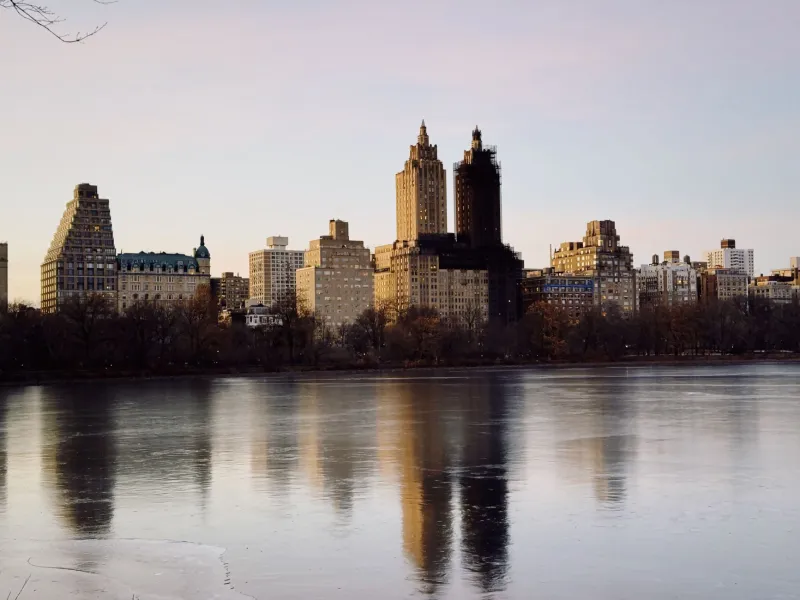
When Lennon and Ono eventually secured their apartment at the Dakota — the grand, gothic-revival building overlooking Central Park that would become both his sanctuary and, ultimately, the site of his death — it represented something genuinely complicated. On one level, it was a triumph: a permanent address, a legal foothold, a declaration that he intended to stay. On another, it was an acknowledgment that stability in New York City came at a price that most of his contemporaries in the arts could never pay.
The Dakota in the 1970s was already an anomaly — a building of architectural grandeur and financial exclusivity standing at the edge of a park that was, in those years, fraying badly. The surrounding Upper West Side was in the grip of the same urban decay that was consuming much of New York, a city lurching toward its infamous 1975 fiscal collapse. Lennon's Dakota apartment was, paradoxically, both an enclave of privilege and a front-row seat to municipal decline.
This tension — between private comfort and public deterioration — is one that American cities have never successfully resolved. Today, the Dakota's neighborhood is among the most expensive residential corridors in the world. The artists, musicians, and working-class families who once gave the Upper West Side its particular texture have largely been displaced to outer boroughs, smaller cities, or out of New York altogether. The creative migration that Lennon witnessed in its early stages has since become a flood.
What the Creative Exodus Costs a Culture
The displacement of artists from major American metros is not merely a housing statistic. It is a cultural event with consequences that ripple outward in ways that are difficult to quantify but impossible to ignore. Cities become less generative when they can only afford to house the already-successful. The friction, the cross-pollination, the accidental encounters between people of different economic backgrounds and artistic sensibilities — these are the conditions that produce genuine innovation, and they require affordable proximity to survive.
Lennon understood this intuitively. His decision to live in New York rather than retreat to a country estate or a gated compound was, at its core, an artistic and political choice. He wanted the city's energy, its arguments, its street-level humanity. He wanted to be among people, not above them. The Dakota gave him security, but it was the city itself — its chaos, its possibility, its democratic clamor — that fed his work during those years.
When we ask what America loses as its great cities become progressively less accessible to working artists, musicians, writers, and performers, we are asking, in part, what Lennon was asking when he chose Bank Street over Beverly Hills: what kind of culture do we want to live inside, and who do we trust to make it?
The Unresolved Argument
John Lennon never offered a policy prescription for the housing crisis. He was an artist, not an urban planner. But his New York years constitute a kind of lived argument — a demonstration, through the specificity of one man's search for shelter, of the broader forces that determine who gets to stay in a city and who gets pushed to its margins.
The argument remains unresolved. American cities continue to gentrify, to price out, to displace. The creative class that once colonized affordable neighborhoods now finds itself the subject of the same market pressures it once, perhaps unwittingly, helped to accelerate. The cycle is brutal, and it shows no signs of breaking.
What Lennon's housing odyssey offers us is not a solution but a mirror — a way of seeing the present crisis through the particular clarity of a life lived in full public view. He came to New York looking for a home. He found, instead, a city that was already learning to treat belonging as a commodity. Half a century later, the lesson has only deepened.